
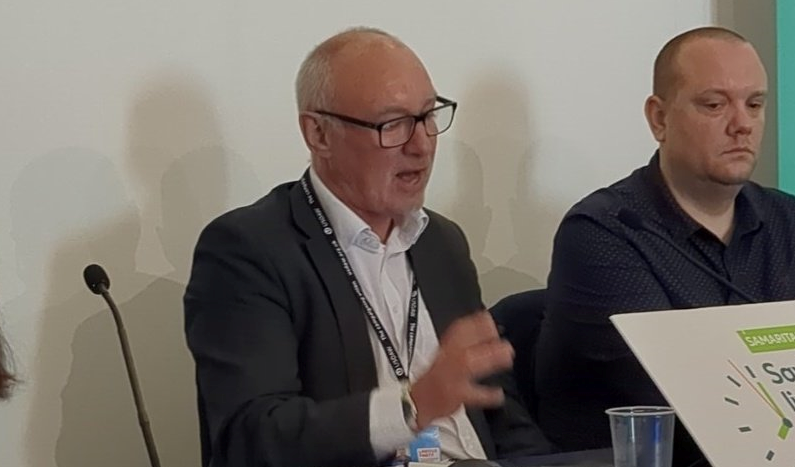
Cllr Jim Dickson is the Cabinet Member for Healthier Communities (job-share) and a councillor in Herne Hill and Loughborough Junction ward.
Today is World Mental Health Day, and this year’s theme is making mental health and wellbeing for all a global priority. Here in Lambeth, mental health is a big priority for us – both in terms of ensuring appropriate and accessible support for those who need it and investing in prevention. Today, we have launched the Love Your Mind campaign, which is all about supporting people in their mental health journey. The campaign will link people to important sources of information and support and will also give people the confidence to approach that conversation with others. Find out more here.
At the recent Labour Party conference in Liverpool, I was pleased to join a fringe event organised by the Samaritans on suicide prevention. It’s a particularly relevant subject for us in Lambeth at the moment as we have just undertaken a major refresh of our suicide prevention strategy in which we have brought together Council, NHS providers and commissioners, voluntary sector organisations, community groups, the DWP, British Transport Police in our Suicide Prevention Partnership to build on the joined-up approach we’ve had in place for a number of years.
Our previous strategy saw the number of suicides in the borough come down from 24 a year in 2016 to 17 a year in 2020 (in line with the national trend) and I’m pleased to say ONS data has recently revealed the number of suicides in Lambeth has decreased even further in with 2021 seeing a 20-year low of 9 confirmed suicides in the borough. We’ll know over the next 2 years if that figure is an outlier, but it’s encouraging.
But that is still too many people taking their own lives, and the new strategy as we put it together needed to consider the additional stresses put on people’s mental health by new factors such as the pandemic and the cost of living crisis.
We continue to target support at high risk groups, including people who are vulnerable economically, young people, LGBTQ+ people, people who misuse substances, are in the care of mental health services, Black, Asian and multi-ethnic communities, migrants and asylum seekers, and those in the prison system.
And with the first year of the action plan, some of the key initiatives have included:
- A major roll out of suicide prevention training specifically designed to be open to everyone free-of-charge, but aimed at key organisations in touch with at risk groups in the borough.
- We have gained access to Thrive London suicide prevention surveillance dataset and that means we can monitor more closely patterns of suicide or attempted suicide in Lambeth.
- We’re raising awareness of the suicide bereavement support services run by South London and Maudsley NHS trust and Mind in South East London, and we are working with Cruse Bereavement Support to launch a specific support group for people bereaved by suicide.
- We are designing a borough-wide mental health campaign, aimed at supporting people in their mental health journey, providing advice on wellbeing and information on how to access services as well as training individuals and voluntary sector organisations to be able to spot the signs of mental distress and sign-post appropriately.
We think this is a strong offer and will build on the previous success of our strategy, but we need a supportive national framework if our work and those of colleagues across the sector is to be fully effective – which we were very clear about when we submitted our response to the government consultation on the new national strategy this year.
It goes without saying that we need significant additional investment in the quality and reach of mental health services – particularly preventative services – but on some of the specifics we have made some important suggestions.
First, we think the wider public should feel that we all have a role to play in suicide prevention; so, we called for a national media campaign, aimed at encouraging all of us to spot the signs of crisis and engage in meaningful conversations with people experiencing crisis or suicidal thoughts, and making training available to everyone.
Another impactful action would be improving the quality of the data available around suicide prevention. Suicide surveillance datasets have been really helpful in planning for suicide prevention but there are still gaps in the data collected at a national level on some of the main risk factors for suicide such as self-harm.
We also want good practice on suicide prevention to be shared more widely. The existing regional communities of practice are helpful but if would be great to find out about good practice further afield in the country.
We very much need more national funding for crisis support, for instance one of our programmes in Lambeth is called Solidarity in a Crisis which provides Peer Support for those who are in a crisis run by people who have experienced crisis themselves. It’s a fantastic service but could have an even greater impact with more funding.
And finally, we think it’s self-evident – and we said this in our response to the government consultation – that more national actions on reducing health inequalities and the wider determinants of ill mental health, in particular around financial inequalities, is also very much needed.
Cllr Jim Dickson